
HomeAdvisor's stump grinding cost guide reports that stump grinding typically costs $250 on average in the United States in 2025, with a typical project range of $120 to $500. Where your job lands inside that range depends on stump size, access, and a question many quotes leave unanswered: does the number cover grinding alone, or a finished, usable yard?
That distinction matters more than most homeowners expect. Grinding turns a stump into a large pile of woody material that has to go somewhere. The Environmental Protection Agency wood data estimated that 18.1 million tons of wood entered the municipal solid waste stream in 2018, 6.2% of total municipal solid waste generation, and 12.2 million tons of that wood were landfilled. Chips kept on site as mulch cost nothing to haul. Chips loaded into a truck add labor and disposal time to a quote that looked cheap. Topsoil to fill the hole and seed to repair settling push the cost higher still, so read any stump removal price as the first line of the bill rather than the total.
Table of Contents
- Typical Stump Removal Costs by Stump Size
- What Actually Moves Your Stump Removal Price
- DIY Stump Grinding Versus a Professional Crew
- The Hidden Costs After the Grind Ends
- Cheaper Options That Skip the Full Grind
- When Safety and Quality Matter More Than Price
- Cut the Bill and Get a Written Quote
Typical Stump Removal Costs by Stump Size
Start with the headline benchmark, then read the other ranges as context. The HomeAdvisor stump grinding cost guide reports that in 2025, the average U.S. stump grinding price was $250, with a typical project range of $120 to $500. That average describes a grinding project, not necessarily complete removal plus restoration.
Why the Published Ranges Differ
Other sources measure slightly different jobs. The HomeGuide stump grinding cost guide puts 2025 stump grinding at $120 to $400 for the first stump and $30 to $60 for each additional stump. The Thumbtack stump removal cost guide puts the 2025 national average cost of stump removal at $207 to $579, with stump grinding commonly costing $160 to $250. The HomeMatchup tree cost guide cites Fixr data for a typical 2025 stump grinding range of $150 to $300 per stump.
| Source (2025) | What the range measures | Cost range |
|---|---|---|
| HomeAdvisor | Average and typical stump grinding project | $250 average; $120 to $500 typical |
| HomeGuide | First stump, grinding | $120 to $400 |
| HomeGuide | Each additional stump, grinding | $30 to $60 |
| Thumbtack | National stump grinding | $160 to $250 |
| Thumbtack | National stump removal | $207 to $579 |
| HomeMatchup | Per stump, grinding | $150 to $300 |
Those figures disagree because some price grinding, others price fuller removal, some quote per stump and others per job, and regional labor rates vary. Read them as a sanity check, not a promise for your yard in the Twin Cities.
A small, shallow stump in open ground usually sits near the bottom of a range. A large stump with wide roots, tight access, or restoration included sits near the top. If a quote falls far below the low end, ask what's excluded. If it sits far above the high end, ask for a line item breakdown before you decide it's overpriced.
What Actually Moves Your Stump Removal Price
Your price isn't built from the stump alone. It's built from three tiers, the stump itself, site conditions, and add-ons you choose or your property requires. Understanding those tiers helps you spot why two neighbors receive very different quotes.
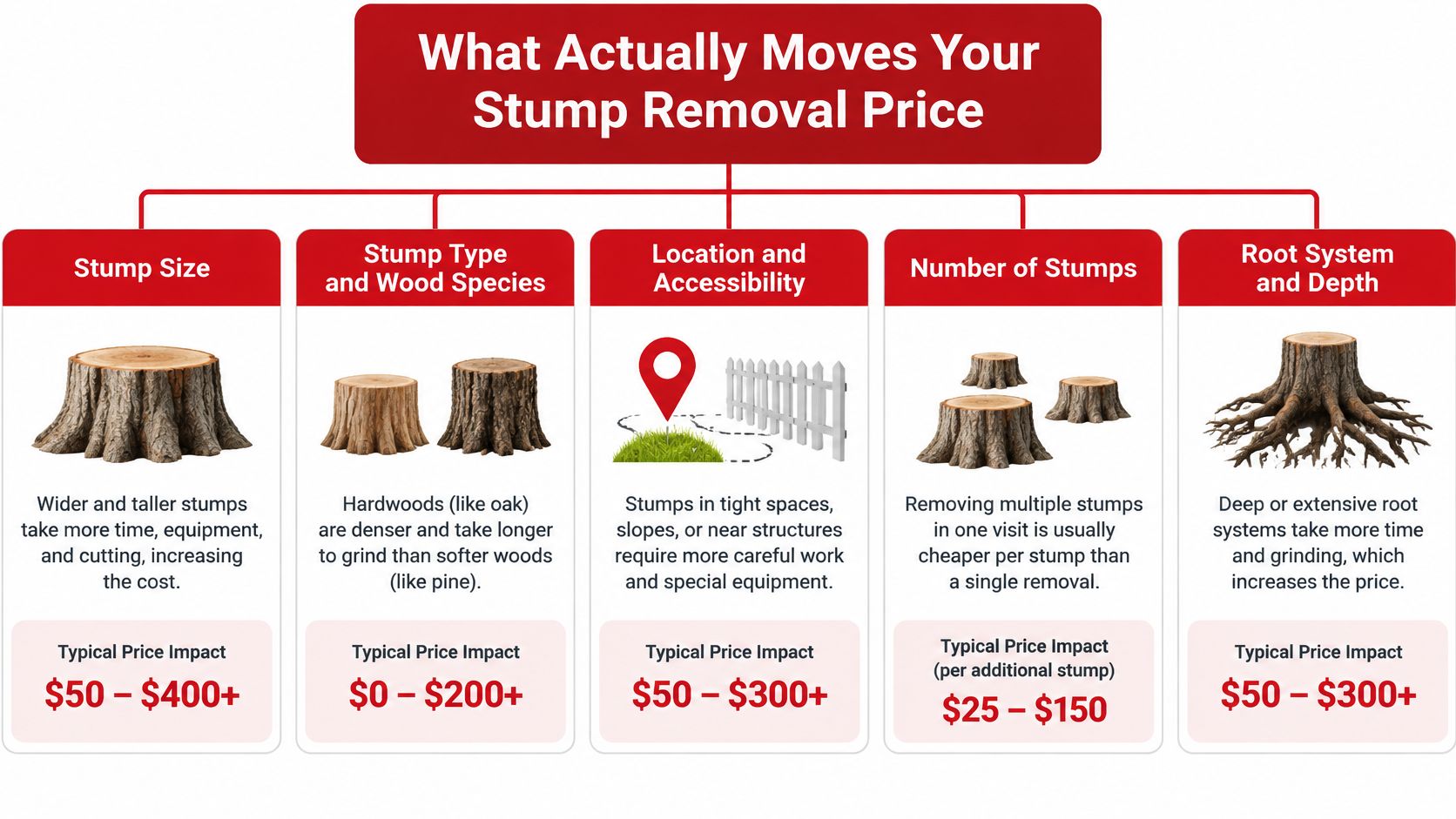
The Stump and the Site
Diameter and root spread control machine time. More wood means more cutting passes, and wide lateral roots extend the path the operator has to grind. Access matters just as much, since narrow gates, slopes, and fences can force compact equipment or slower hand work around the machine. Rock, heavy clay, and buried debris also slow the cutter and increase wear.
Depth is a specification, not a guess. SDSU Extension guidance on stump removal notes that professional grinding commonly reaches approximately 8 to 12 inches below grade and can include the stump's major lateral surface roots. That depth usually supports lawn restoration, while deeper work costs more because more wood must be removed. Our stump grinder service scope should state that target in writing so you aren't comparing different jobs.
| Price driver | Why it changes the quote | Effect on cost |
|---|---|---|
| Stump diameter and mass | More wood means more passes and more time | Higher |
| Root spread | Wide lateral roots extend the grinding path | Higher |
| Access and gate width | Narrow gates, slopes and fences need compact equipment or hand work | Higher |
| Soil and buried debris | Rock, clay and old footings slow the cutter and add wear | Higher |
| Grinding depth | Going deeper than the standard 8 to 12 inches adds passes | Higher as depth increases |
| Number of stumps | Multi-stump jobs spread setup across more work | Lower per stump |
| Chip removal | Hauling adds labor and truck time; leaving chips on site costs less | Higher or neutral |
| Restoration (topsoil, seed, grading) | Adds materials and labor beyond grinding | Higher |
| Disease or quarantine status | Requires compliant disposal and documentation | Higher |
Add-Ons That Change the Total
Chip hauling, topsoil, grading, and seed aren't automatic parts of grinding. Disease or quarantine status can also require a different disposal plan. Before you request quotes, measure the stump, photograph the gate and slope, note nearby structures, and decide whether you want chips kept or removed. Those answers reveal which drivers apply to you.
DIY Stump Grinding Versus a Professional Crew
Say you've got a 14-inch maple stump beside a fence gate in a Minnetonka backyard. That counts as a medium stump, the size range typically quoted at $200 to $300 by a professional crew. On paper, DIY looks cheaper. You rent a grinder, buy fuel, wear eye, ear, and leg protection, and give it a weekend. Then you discover the root crown runs deeper and wider than the visible stump, the gate limits how you can position the machine, and each pass throws chips you still have to move.

That example shows why rental cost alone is the wrong yardstick. The comparison is your total effort and risk against a written quote that includes cleanup. If you're still weighing methods for getting rid of tree stumps, separate grinding from excavation first. They're different jobs with different results.
Grinding Is Not Excavation
The Dartmouth guide on DIY stump removal risks explains that grinding uses a rotating cutting wheel to reduce the visible stump to wood chips and typically reaches an agreed depth below grade, while lateral roots and deeper wood may remain. Excavation removes more of the buried stump and associated roots but generally causes greater soil disturbance. Your scope should say whether your goal is removing a mowing obstacle, removing the root crown, or clearing substantially all buried wood. A professional quote makes that distinction explicit: stump grinding takes the stump flush and below grade, while full removal covers stump and root extraction.
Cleanup, backfilling, grade restoration, and watching for settling are separate tasks. They don't happen automatically because a machine ground the stump. That's true whether you rent equipment or hire a crew, so compare any stump grinder rental quote against the full scope you'll still handle yourself.
| Factor | DIY Grinding | Professional Grinding |
|---|---|---|
| Upfront cost | Grinder rental, fuel, cutting teeth and protective gear | Per-stump or per-job quote with a written scope |
| Depth reached | Often shallower and depends on operator skill | Commonly 6 to 12 inches below grade, scope stated in writing |
| Utility locate | Owner must request a Gopher State One Call locate before machine digging | Crew can confirm locate marks before starting |
| Safety exposure | Rotating cutter, flying chips, buried lines and uneven ground fall on the owner | Trained crew with licensing and insurance |
| Time | Often a full weekend or longer for a first-timer | Hours on site for most residential stumps |
| Cleanup and restoration | Owner handles chips, backfill, topsoil and grade | Included or priced separately; confirm in the quote |
| Recourse if damage occurs | Owner pays for any repair | Insurance and written scope define responsibility |
The Minnesota Locate Step You Cannot Skip
Machine digging triggers a legal step before the cutter starts. The Faribault Daily News reminder on contacting 811 explains that Minnesota requires contacting Gopher State One Call before excavation performed with machine powered equipment, and utility operators have 48 hours to complete locates, excluding weekends and legal holidays. The waiting period begins at 12:01 a.m. on the day after the request is submitted. Mark the excavation area in white and don't start until responses are confirmed.
Practical rule: DIY suits a small, shallow, healthy stump in open ground with no buried utilities nearby. Hire a professional for anything large, deep, near structures, or near underground lines.
Cost alone shouldn't override that rule. A rental can look cheaper until you add a second rental day, chip disposal, topsoil, and your own time correcting an uneven result. A written estimate from a licensed and insured company such as Stump Sniper states the grinding depth, cleanup scope, and final price before work begins, so the comparison stays honest.
The Hidden Costs After the Grind Ends
Grinding isn't the whole job if your goal is a lawn you can mow, seed, or sod. The machine can leave the stump below grade and still leave you with a hole full of chips, loose material that settles, and soil that won't support new grass yet. That's where a cheap quote often becomes expensive.

The Illinois Extension guide to stump removal explains that fresh stump grindings have a high carbon to nitrogen ratio, and soil microorganisms consume available nitrogen while decomposing the carbon rich material, temporarily depriving new turf and other plants. This nitrogen immobilization explains pale or failing grass even when the stump is mechanically below grade. Chips spread on the surface as mulch behave differently from chips mixed into soil, so placement matters.
What You May Still Pay For
Iowa State Extension guidance on planting grass after stump removal says wood chips, sawdust, and root fragments should be removed before planting, quality topsoil should replace the lost volume, and the area should be lightly mounded because it will settle. It also warns retained shavings can alter soil structure, moisture retention, and nutrient balance. Plan for these items if they're not in your quote.
- Chip hauling: Removes material that would interfere with turf establishment.
- Topsoil and grading: Replaces lost volume and creates a level surface, slightly mounded for settling.
- Seed or sod: Covers the restored area once suitable soil is in place.
- Watering and follow up: Supports establishment and corrects low spots after settling.
The same logic applies if the stump sits where you later want hardscape. Designers who plan patios with shade and drainage in mind still need a stable, properly filled base, not a chip filled depression. Ask for two prices side by side, grind only and restoration ready, and confirm what our stump grinding cleanup includes before work begins.
Cheaper Options That Skip the Full Grind
You don't always need a full grind. The right cheaper option depends on what problem the stump causes and what you plan for that spot.
- Leave it in place: Reasonable if it's off the mowing line, isn't a trip hazard, and doesn't block planned work.
- Shallow grind to grade: Useful when mowing clearance or a trip hazard is the only problem.
- Partial grind for a planting bed: Grind enough to use the area, then cover it with surface mulch instead of paying for turf restoration.
- Cut flush and let it decay: Avoids machine work and soil disturbance, but the stump remains visible while it breaks down over years.
- Skip excavation: Sensible unless hardscape, footings, utilities, or major regrading require more buried wood removed.
Check disease and pest rules before leaving or cutting ash, elm, or infested wood, because disposal requirements can change your options. Review our tree stump removal options against your intended use, and still complete a locate before any digging near buried lines.
When Safety and Quality Matter More Than Price
Tree care involves significant risks, and stump work shares equipment and site hazards with that trade. The Texas Department of Insurance tree trimming safety fact sheet reports that tree care incidents in the United States account for about 80 worker deaths and at least 23,000 chainsaw injuries treated in hospital emergency rooms each year. It also notes grounds service workers make up less than 1% of the total workforce but account for about 3.5% of workplace fatalities.
Stump grinding isn't felling a standing tree, but it can involve heavy machinery, rotating cutting equipment, buried utilities, unstable roots, uneven terrain, and flying debris. A quote that shifts injury, utility, or property damage risk to you isn't cheaper. Licensing, insurance, site assessment, and controlled operation are cost protection, not premium extras.
| Situation | Prioritize | Why it matters |
|---|---|---|
| Stump near buried utilities or underground lines | Gopher State One Call locate and marks before digging | Machine digging without confirmed marks risks strikes and injury |
| Stump near a foundation, wall or structure | Insured, licensed crew with controlled cutting | Property damage can cost far more than the saving |
| Diseased, infested, ash or elm wood | Compliant disposal and documented transport | Debris may not stay on site and quarantine rules apply |
| Stump on a play area, walkway or slope | Finished, trip-free grade and clear restoration plan | Uneven ground creates lasting trip hazards |
| Stump in a lawn to be reseeded or sodded | Restoration-ready scope with topsoil and grading | Grind-only work can leave a lawn that fails to establish |
| Small, healthy, open-ground stump with no hazards | Grind-only or DIY route is reasonable | Low risk allows the cheapest route |
Disease deserves specific attention in Minnesota. The City of Lakeville diseased tree FAQ states that debris from infested or diseased trees cannot be left onsite, ash and elm wood must not be retained as firewood, and infested ash should be transported only to approved sites within the relevant Minnesota Department of Agriculture quarantine area. That can make ordinary chip reuse inappropriate and change the price.
For stumps in the higher risk rows, use our professional stump removal process and confirm responsibility in writing. Stump Sniper is a licensed and insured stump removal company. The cheapest route is reasonable mainly for a small, healthy, open ground stump with no structures or buried lines nearby.
Cut the Bill and Get a Written Quote
You can lower the bill without cutting safety or the steps that make the yard usable. Start by reducing uncertainty and setup time, then make every provider quote the same scope.

Six Savings Moves That Actually Help
- Send a photo with a tape measure: Texting a photo of the stump with a tape measure to (952) 254-7777 gets a 15% discount on stump grinding and helps us check scope before visiting.
- Bundle every stump: One visit spreads travel and setup across more work, so the per stump rate usually improves.
- Keep chips as surface mulch: If no turf is planned, reuse suitable chips in beds instead of paying to haul them.
- Clear access first: Move vehicles, open gates, flag sprinklers, and secure pets so the crew isn't waiting.
- Combine with neighbors: Ask whether neighbors, an HOA, or a shared lot can join the same visit.
- Offer flexible timing: A wider scheduling window can help us fit your job efficiently, and same day service may be available when capacity allows.
For mulch reuse, EPA mulch guidance recommends applying approximately 2 to 3 inches of mulch for non-turf beds containing shrubs, trees, perennials, or groundcover. Keep those chips on the surface in beds, not mixed into soil where you'll seed grass.
Compare the Same Job in Writing
The first step with us is a free quote, with a transparent written estimate based on stump size, quantity, accessibility, and surrounding property conditions. Compare quotes only on the same target depth, surface root scope, chip handling, and restoration. As with any home project where you review permits and project timelines, get the scope and sequence confirmed before anyone starts.
A trustworthy quote names stump size and quantity, access limits, target depth, surface roots, chip handling, restoration, timeline, and final price. If one item is missing, you don't yet know the true total.
Never cut the locate step, the licensed and insured requirement, or topsoil replacement when you're reseeding. Those aren't savings. They're costs moved into the future, often with interest in the form of rework. We serve Minnetonka, Deephaven, Excelsior, and the wider western Twin Cities with written estimates before work begins.
Text a photo of your stump with a tape measure to (952) 254-7777 for a free, transparent written estimate from our licensed and insured crew, and we'll price grinding, chip handling, and restoration as clearly separated options. Visit StumpSniper.com to request affordable stump removal across Minnetonka, Deephaven, Excelsior, and the western Twin Cities, and get a finished yard price you can compare with confidence.